Archive for 2012
Devastating Pain
 I stare at the white box, curser flashing in my face. Scrolling through an index of recent observations…trying to pick out unique thoughts, pointed words, and determining what/if any of the days experiences are worth sharing with the twitterverse. I consider my agendas…what I want to communicate to the world…in this case my professional world…and the cursor continues to blink…I keep things tight at the moment….bite my lip and sit out of the mobile web conversation…bite my lip and don’t rail the arrogant VC that presumes I want his money (a presumption that couldn’t be further from the truth)…wrapped up in this self involved process of strategic content creation…as I replay the index, and tire of the mundane, or already said…I glance to the right of this empty white box, and see Eghosa’s tweet in which he admits he has wept…a rare display of emotion in a usually strategic feed of self-advancements and clever quips…click through to the words of a mother who has lost her 6 year old Noah…and sure enough, I well up myself. I am not a parent. The loss of a child is not a pain I immediately understand. Her words bring me into the pain. I have thought about the massacre in Newtown on a number of different levels…I have been involved in conversations around policy and action…but only in reading the words of a mother, speaking to her slain son…do I begin to feel Newtown. I am so sad. My heart aches…my agenda for creating this content is base…it stems from a need to share with you the fact that I am human…to revel in humanity…to trump professional agendas and express a sense of connection to Noah and his mom, and you, and every other being on this earth. We advance products that strive to connect all human beings on earth. We laud Facebook for connected a billion people together partially because of the beautiful visualization of humanity it provides. It seems as though we should attack products that rip us apart with the same force and energy. Demandaplan is a good place to start: http://we.demandaplan.org/
The Edge
 The edge: the edge is a character trait, type of intelligence, and behavioral style that optimizes for the self irrespective of, but not necessarily at odds with, collective interests.
The edge, or an edge, is not unique to some, but rather present in all…it is a base level intelligence that is responsible for calculating toward optimal outcomes for the individual…what is variable is a higher order function which is an individuals choice of how influential the edge is in how she carries herself in a given setting. Also variable is the strength of this intelligence…some people are extremely tuned to how their own and others’ actions impact their personal satisfaction…they tend to also be extremely tuned to the presence of edge in those around them…they detect when another is acting from “the edge” and instinctually calculate if the other’s intention is good, bad, or neutral for them…if one chooses to be ruled by the edge, that calculation is immediately followed by the action most likely to minimize adverse impact on one’s self interest.
Ok, sorry for the abstract description, but I wanted to really get across what the edge is. Some more visible manifestations of the edge, or related real world examples might be seen in, for example, styles of poker. He who plays extremely tight, with perfect calculation, and optimizes for each individual hand, likely has a strong expression of “the edge.” He who plays loosely, chats with the table, makes some friends, makes a couple calls for the fun of it, may either not have as developed an edge, or may have made the higher order decision not to be ruled at the action layer by it. Now, a few things worth pointing out. The edge player does not necessarily win against a non-edge player…each player has a style that works for them…in the short term, or on a given hand, I’d put my money behind an edge player if I had to bet…but over the life of a game, or many games, the same does not hold…I say this because persistent self optimization is not necessarily the most effective path to overall optimization.
Last night I was talking to a close friend and former Hyperpublic engineer, Eric Tang, about the role of “the edge” in business…and more broadly how to carry yourself in a professional and startup setting. We talked about a mutual friend who we agreed is incredibly smart and competent. This friend has ambitions of starting a company one day, and I said “he will be amazing…the only thing that might get in his way is his edge.” Eric’s response was sort of confused…he viewed the edge to be a powerful tool (which it is) in carving one’s way through startupland…but I explained that in my experience, early startup environments are often to fragile and vulnerable to support a heavy-edged leader (and by translation…culture). I told him, the edge feels like a sword…that you choose to brandish…and more often than not, I prefer to leave it holstered. I’d much prefer to lead with love and respect and engender a culture that softens the edges of everyone, than allow for an active “dialog of the edges” to emerge within my organization…
I am not saying that an edge is not important, and there is certainly a time and place for it..in fact, when I do brandish said sword, and act under the influence of the edge…I am fucking ruthless about it…but especially now, a little later in my career…I am very careful and conscious about when I choose to use/listen to it. I have always had a very tuned edge, and when I was younger, not only was I ruled by it, but I couldn’t fathom why anyone, especially in a professional setting, would choose to mute it. I viewed those who did not act with the sharpest of edges as less sophisticated of shreud…but I was wrong…I attribute much of my current understanding on this subject to Kenny…who you might have heard…has an edge that will cut glass…but his selection of when that edge gets expressed is masterful and nuanced. Of course, there are those that get far under persistent influence of the edge…but it is not the only way and not long term optimal approach for many. If you are playing the long game…and by long game I mean lifelong pursuit of excellence in the professional arena…I believe there is more upside in an optimization strategy that checks the edge’s influence over day to day interaction.
Read Full Post | Make a Comment ( 2 so far )We Can Do Anything
 I don’t know if surprised is the right word…because I’ve now done this enough times to know that nothing is surprising…but amazed certainly seems a fitting alternative. Amazed that no matter how much things have changed since the last time I did this, some things…that you would think are contextual…are actually constants…each time I start something new…I think I know where I am as a person, I think I know what I have learned…I think I know what I know, I think I know what I care about and what I don’t, and what moves me, and how I want things to be…and I carry that concept of the way things are, quite confidently and assuredly…right up until the moment where I am standing on the diving board, toes hanging over the edge….visualizing my movement though the air, breaking the plane of the water, propelling myself underneath the surface, and ultimately reemerging again…and then, with a jump…sure enough…it becomes clear that the view from the edge was distorted…and that there are certain dimensions to starting a company that…for lack of a better term…are simply water activated.
Today I am wet…I realize that sounds disgusting…but in the metaphor of diving into the pool, there is no other way to describe it. That which laid dormant since we sold Hyperpublic to Groupon on February 17th…all which is water activated, seems to have emerged…for good and for bad…I say for good and for bad…because, which will be no surprise to you or anyone reading this blog, this process has inescapable joys and inescapable struggles…there is no “I sold my last company, so this time it will be ‘struggle light’…and there is no ‘I have done this a few times, so this time it won’t be as special’”…in fact…part of what’s special is interacting with and touching the struggles that are constants…the exhileration of a difficult task, the risk in putting yourself out there…the feeling of your heart leaping up into overdrive…inexplicably…when the calendar reminder tells you “10 minutes to game time.” These are phenomena that no entrepreneur, independent of their past experiences and successes/failures, can…or even wants to…escape…these are the thrills and anxieties of being in the game…and it is a feeling more alive than I can describe.
I was talking to a friend yesterday who is not part of this world and he asked me to share with him “what is it?” “what is this feeling that has you jumping out of your seat?”…he literally couldn’t understand the speed of my energy and wanted me to articulate and share it with him…I thought for a moment, and really tried to isolate what it was that I was experiencing…and the only words I could find…which I think are the right words, were “We can do anything”
the belief and exploration and testing and celebration of this principle is at the core of my joy and why I love to start companies.
A note on team: if you want to come on this journey…and explore this principle…if you’ve ever read this blog and thought “that dude would be cool to work with”…you are invited. Jordan.cooper@gmail.com…I speak from experience when I say it will be fulfilling and exciting and so so so hard…senior and junior, all skills…problems will be engineering and design intensive. The bar is excellence…tough to join, once in, you will enjoy the company of people who share your aptitude, ambition, curiosity, ethics, and general dopeness. If we do it right, you will not be the best on this team, but you will be on the best team…which is way more fun.
Read Full Post | Make a Comment ( 3 so far )
Mobile Distribution Hack
 So here’s what I was thinking about yesterday. It is no secret that distribution in the mobile ecosystem is FUCKED. I complain about it in tweets at least once a month. No matter which way you slice it, getting people to download your app, even if your app is dope, is really freaking hard. As was the case 24 months ago, today there are still very few channels by which you can acquire new customers. The fact that “get featured in the app store” is the number one method for building a native user base is completely absurd. Even if you can get people to “share” in your app, a deep link into the app store just sucks. The drop off is huge. Signing in and installing something before a user gets any value is completely contrary to the way users have become accustomed to acting on the web. It’s the equivalent of forcing registration in a web app before delivering any value to the user. Imagine if Yelp made you register before you got to read reviews on their site…just doesn’t work. There is this big step in the funnel from when a user is exposed to a brand to when they commit to it that is simply missing from the native mobile ecosystem. It’s so bad, that if I had a mobile app that I was trying to spread, I would drive recipients of any share experience to a web based UX where they could interact with my application in a non-native environment…I’d try to win them there…and then attempt to convert my web users to native mobile users down the line…
Anyway, these problems got me thinking…if everyone gets a small install base out of the gate, and then struggles to grow it organically or socially the way they would a web app, that must mean there are A TON of “walking dead” apps. You’ve heard of “walking dead VC’s” that still exist and have a brand but don’t do anything and don’t die…”walking dead apps” are apps that have install bases of between 10,000 and 100,000 but no growth and declining engagement. These apps will never be meaningful companies, will never make any money, and at some point I’d imagine they just disappear. BUT, one thing walking dead apps have is a footprint…small but valuable real estate on a user’s phone. Granted the user probably doesn’t engage with their app, but they probably haven’t deleted it either…so how much is that footprint worth? Well…if apps like Groupon or Zynga are willing to pay $5 an install, that would mean a crappy app with 10K downloads is sitting on $50,000 in IOS real estate. What if…theoretically, there were a way for GRPN to buy “crappy app” for $2 an installed user, replace crappy app client side code with GRPN client side code in an “update”, send an email or push from crappy app to userbase saying “crappy app is now GRPN, check out the app already on your phone”…and then GRPN converts some % of crappy app’s users to GRPN mobile installed users? I realize the mechanics of this sound ugly…but if someone were to come along and buy lots of crappy apps, put them together in one network, build a large installed footprint, and then sell the real estate plus “services to facilitate and optimize transition/conversion” from crappy apps to “buyer’s apps” …that might be kind of interesting…or better yet, what if someone built a marketplace where crappy apps could list themselves, there install bases, their recent active user base, and there category…and buyers could come along and intead of buying ads inside mobile apps that drive to deep links, they could buy blocks of installed real estate on mobile devices…then crappy apps would have someplace to monetize their now worthless apps, which would lead to more apps being built, which would be good for the ecosystem and Apple actually, and successful apps would have a channel where they could spend $ to effectively acquire IOS real estate. I realize there are tons of problems with this (Apple’s hissy fit being the primary)…but I’m interested in the idea of fledgling native apps selling installed real estate instead of adspace within their apps. Give em’ a performance based kicker on successful transition of installed base to “buyer’s app,” unlock more value for those who have been punished by the distribution wall of death…just a rant born out of frustration with the state of the state
Read Full Post | Make a Comment ( 9 so far )on an inspired day
I sat on a stoop beneath a statue in a circle and read a note from a boy about to become founder.
I looked in his eye at the passion and hunger, I remembered the time I dove in myself.
I envied the pain that would come with his journey and listened as he spoke of what was ahead.
I cautioned and warned to make sure he was ready, and embraced his journey as though it was mine.
We sat in the sun and watched life for an hour, then parted to move into the future.
He boarded the subway, wrought with anticipation.
I boarded a treadmill to burn off my laze.
I thought of the question I always come back to, and let it simmer amidst the sea of perfect asses.
I walked into J crew, to replace soiled clothing. A refugee for a moment from minor inconvenience.
I have moved to all black, for it is more simple, and fashion was never my strength anyway.
I sit in the dark, screen glows in my face. The page was once blank, now covered in words
Read Full Post | Make a Comment ( None so far )Vision
 Vision fascinates me. It is what I focus on when considering investment in a founder and it is my primary competency as a founder. No startup realm is cut and dry, but within the dimensions of a startup, vision is by my own admission most nebulous, fleeting and difficult to measure. After about a year building our team at Hyperpublic, we got pretty good at measuring engineering talent. Our interview process was a series of meetings and conversations, as well as a technical test. There is, however, no test for measuring vision. One reason why “visionary talent” is difficult to assess is because it is not “evenly distributed” between the near and distant future. Said another way, a founder may have strength within a certain focal length (i.e. near term vs long term), but weakness at a different length.
Near Term Vision
Some people “see” the present very clearly. This is near term vision. “Today” expires before a thought or decision can manifest, so let’s say the window of value for a founder with strong near term vision, is defined as tomorrow through 90 days. Near term vision is easier to calibrate than long term vision, for no other reason than a founder’s current product is a manifestation of her near term vision. How well she sees today is translated into a solution that she builds which, if her near term vision is strong, is consistent with the current state of today/the market/the user/the problem. The founder archetype who builds to solve the problem that she has today, or to scratch her own itch, or who begins with a simple feature and develops a startup around it, I believe has a more developed near term lens. This is not to say she lacks in the medium to long distance view, but she tends not to lack in her view of the present and near future. If her product does not build traction, or clearly violates some truth or realty in the present, that is a reasonable sign that her near term vision is not extremely developed.
Medium Term Vision
Push out beyond the tomorrow, or the 90 day window, and vision becomes harder to measure. There is no tangible manifestation of the way a founder sees the world unfolding…short of her plan. Now this plan is not just a product roadmap, it is also a company roadmap. The medium term we can define as 90 days – 12 months. In measuring medium term vision, the conversation must orient around not just current product extensions, but also company positioning. Does the founder have a sense not just of how things exist in current form (user preference, consumer behavior, market behavior, etc), but also the direction or change that is occurring or happening to the present. Directionally, is a set of characteristics or phenomena moving toward or away from a given point? What dimensions or aspects of her product will be successful as the phenomena moves on that more macro curve and what will become stale or irrelevant. What are competitors and tangentially related companies building and how will their evolution change both her user’s thought/behavior as well as her future user’s thought and behavior (I use “user” interchangeably with “customer” and recognize that this principle applies to non-consumer facing companies as well)? A founder with strong medium term vision can see and articulate the “bridge” between where she is today and where she will be in a year. She is able to define a plan based on let’s call it “one round of financing” (or 12 months) that does not violate directional changes in the market and population, so as to ensure that she is as relevant or more relevant in one year than she is in the present. Medium term vision is essential to interaction with the capital markets and the M&A markets who tend to measure not just the value of a startup to the present market, but the expected value of that startup down the road.
Long Term Vision
Long term vision is closest to my heart and hardest to calibrate. In long term vision, metrics and heuristics cross the chasm from logical to spiritual. The inputs that influence a founders view of the future when we look, say 5 years out, are nuanced and often inarticulable. Often these inputs, while real, and definitely consumed and processed by a founder, get rolled up into justifications around “feeling”, “gut”, and belief. The founder with true long term vision both consciously and unconsciously consumes and processes signal from the population and market that most will not process for years to come. Medium term trends will bring this signal to the forefront of market consciousness on the ascribed timelines, but the founder with developed long term vision has a jump. Excellence in this realm can be particularly hard to identify, as the timeline of relevance is long enough that any articulation of long term vision can and often will violate near and even medium term realities. A founder with conviction In their long term vision can ignore and disregard the very signal that is driving the rest of the market. Once Joel Cutler described to me a founder that “can see around corners.” It is a phrase that has stuck with me. The long term thinker’s life is not easy. Communicating the future to the present and medium term thinkers can be exhausting and challenging and isolating. But she who sees around the 5 year corner, if competent but not necessarily excellent in the near and medium term, takes all.
Often, the founder with true long term vision makes up for the disconnect between her vision and the present with passion. She must amass resource not around the solution she has in hand, but around a persuasion of all that she correctly sees something invisible….and the challenge of anyone who might hitch their wagon to this founder (be it a challenge to a recruit, or investor, or partner, or lover) is to identify who amongst the snake oil salesmen is actually the prophet.
Read Full Post | Make a Comment ( 3 so far )Thoughts From the Dugout of Team Suffering
 Last night I went to a party where I ran into Adam Rich. Adam is co-founder of Thrillist and runs the editorial side of their business. I went over to say hi to him, and after some friendly chatter, he mentioned that he’s been reading my tweets and that he’s been enjoying them…he said “they’re good…but they’ve been better.” I realize how absurd this sounds to be discussing seriously…and it was a joke…but it was serious too. “My tweets” in this conversation was a euphemism for public voice, and encompassed in his statement was an indication that my blog isn’t as interesting to him as it used to be. I asked him, “what’s missing?” and his response was “you.” He said anyone who reads my blog could and also probably does read Business Insider, etc…so he doesn’t need analysis on the market, or trends or how to xx …he said anyone can write that and there is a surplus of places to find it. I thought for a moment, and frankly agreed.
It hasn’t always been this way, but it is now. Startup content is a saturated market. It used to be that Fred Wilson or Chris Dixon would write about term sheets or fundraising or distribution or whatever, and because this knowledge was previously inaccessible to young and first time founders, it was enough and extremely compelling to shine light on these subjects. When I started writing this blog, I did the same…I’d find areas that Fred and Chris hadn’t covered and I’d write about them.
Mixed in with the inside baseball of startups and venture capital, I used to write a lot about my personal journey and feelings and experiences as I navigated life as an entrepreneur (I think this is the “you” that Adam was referencing)…I was not shy about sitting down to this computer, saying “how do you feel write now?” and then writing 3 paragraphs about the day’s stress and hopefully some solution I had hacked together to resolve or at least live through it. This was easy content for me to write because it was me and every other kid hustling his ass off in the same boat, just trying to survive and snatch some small victories from the “other guys.”
So who were the “other guys?” They were fancy VC’s, successful entrepreneurs, market incumbents, and generally anyone who was up high, looking down at all of us…doubting us…comfy and cozy in their fucking mansions and fancy cars…getting in our way and frankly not empathizing with our day to day struggles…they were the guys who forgot that they were once like us…they were the guys who would never let you know that they put their pants on one leg at a time…guys like this. my blog was in many ways a rebellion against anyone who was not on our team. Our team was comprised of the unproven, the hungry, the uncomfortable, the underdogs…frankly our team was “team suffering.”
Wins on “team suffering” were also not hard to articulate or write about. When you posted for a month about how you can’t sleep because of what this life is doing to you, and then you finally win a deal or get some funding or whatever, the market roots for you. They champion you. They have seen and read your pain, and know you are not an “other guy” and they want you to win…in both adversity and victory, as long as you are on “team suffering” the market supports you. This support fueled me and also kept my spirits high. Instead of looking for support from my family or friends, I really looked to “team suffering” to help me through startup life. I felt a sense of belonging and deep community here, and the more I shared, the more people would emerge and express empathy, compassion, and frankly affection. I deeply valued my position on “team suffering” and felt lucky that on occasion, through this blog, I could act as a megaphone for what my peers and friends were experiencing.
Which brings me back to Adam’s comment that what my blog is missing is “[me]”. I hear that, and I agree. The reality is that I’m not suffering right now. My challenges, while real, will not resound with the community that I have long and continue to feel a part of. They are not the daily struggles of “team suffering”…and I will not amplify the voice of “the other guys” because I fucking hate them. So I’m kind of voiceless until I start making life hard again…which I’m working on…
Read Full Post | Make a Comment ( 1 so far )My Ambitions
 Paul Graham recently wrote: “[a startup] is at first is no more than a declaration of one’s ambitions.”
My ambition is global in scale, but the inverse in culture. On one hand, I am obsessed with the human population as a system. I despise the concept of borders and the segmentation of our population by arbitrary lines on a map. I do not value what is near over what is far away, and I aspire to build a business that directly or indirectly reminds people that we are one. Jack Dorsey recently quoted William Gibson in saying: “the future has already arrived, it’s just not evenly distributed yet. So our job as founders, as entrepreneurs…is to distribute the future that’s already here…and to do so as quickly as possible with the right amount of purpose and right amount of values” In the future I see, there is only one country. It is earth. Language as a barrier is nothing more than an absurdity. Physical distance as a barrier is nothing more than absurdity. I want to pull people into a future where we value a human life and experience equally, independent of our social of physical proximity to it. There are many ways to destroy the distance between people. The most visible leaps in this arena seem to exist in the networked communication between individuals. Whether the telephone, the internet, the Facebook (see how I did that.. ha), or the Twitter…step function changes in the way people communicate are narrowing the chasm between distant individuals, and more profoundly, amending the young individuals’ concept of self as distinct from another, whether that other be local or international. These are beautiful and evolutionarily significant efforts to pull our population into the future. There are, however, many other forms that this progress can take. A product or service that achieves global penetration shows the world common experience, despite our differences. There is something about McDonalds at the end of the earth that reminds us that we are far away, but the same. A beautiful vision that isolates some facet of humanity or human experience, and displays it back to the user or consumer, can speed our acceleration to a single networked system. An airline, or cruise ship operator, that enables us to break through physical deterrents, to interact with the previously separate, again pulls us into the future I see. My ambition is along these lines. There is value in achieving this phenomenon domestically, in showing the farmer in Indiana his sameness to the ballerina in New York City…but my ambition is bigger… it is global.
When I say my ambition is the inverse in culture, I mean it. The inverse of global is local, and the extreme of local is self. Inbetween local and self (so perhaps not the true inverse) is family, and that is how I want to live my days. A family irrationally values its members over all else. It does not recognize someone socially or physically distant as equal. It is an irrational allegiance and loyalty and love and respect for a small and distinct group…it does not scale. At Hyperpublic our culture was family. We were only 10 people when we were acquired by Groupon and I loved spending the majority of my hours with our family. So my ambition is to do the impossible. To build a culture of family into a business that scales globally. Like everything else in my life, in business I admire and envy paradox. And so, in my new startup, which is a tiny little baby, virtually undefined, I endeavor to build this paradox. That’s as far as I’ve gotten (well maybe a little further), but these are my ambitions, clearly stated, and now, at least according to PG, I am a startup.
Read Full Post | Make a Comment ( 3 so far )7 thoughts about sensors
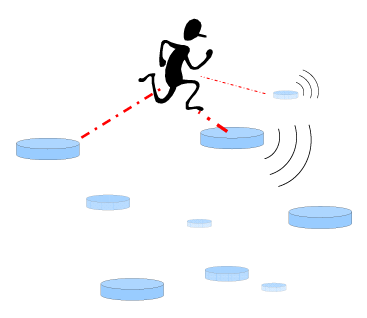 So…here are a few thoughts about the sensor market:
1) sensors that track human behavior are pretty boring. You can put it them in a wristband, or a shoe, or a phone, or a necklace but fundamentally there is only so much you can do with the information of how many steps I take and what direction I am going. Accelerometer, altimeter, pedometer…all pretty boring no matter how an application wraps the information. There is a reason that the output of these sensors has stopped at the visualization layer, and not really broken into intelligence…it’s because that shit is not very meaningful…in a vacuum at least.
2) Sensors that track things are fascinating but early: You can put them in your home, you can put them on your garage door, you can put them on your pill bottle, or your tooth brush, or your car, etc…and they can tell you what’s going on with any given thing. Is it getting hot, is it getting cold, is it on, is it off, is it moving or stationary, etc, etc., etc. Here the applications can become more interesting…but there are challenges abound. Size, cost, form, connectivity protocol, and very importantly distribution and the related network requirements for truly meaningful aplications all hamper what we can loosely refer to as “the internet of things”
3) Sensors that track things do not share a standard protocol but there aint gonna be twelve base stations in my house, so something is gonna have to give on data portability at the API/cloud layer…but none of this is defined and its hard to see a software application being built independent of the hardware layer due to lack of penetration in the short run…so it seems like a long slug to be the centralized consumptive/intelligence layer in the near term…unless…you are the incumbent/enterprise…which brings me to #4
4) In the near term, dense sensor distribution seems more plausible through the large OEM than direct to consumer…but…the General Electrics and Time Warners of the world that are positioned to scale distribution of the base station and/or the connected things both lack the critical software application DNA to complete the picture at the consumer layer…
5) so fuck, where is the opportunity? For one, I think you could build a nice little business providing turnkey sensor/software solutions to large OEMs…but boy will that be a bitch of a sales cycle…regardless, I think you could do it for them…probably through a lens of analytics…it’s not enough to promise the OEM’s better user experience for their customers…I think the sale looks something like “you sell 2 million blenders a year, and the second they leave the shelf at Walmart, they go dark and you have no idea what usage and performance look like until some small portion of the user base tries to return it or replace it…by letting us connect all of your things with sensors that talk to a base station and ultimately the cloud, we can give you insight that will inform your product development and marketing decisions in a much more intelligent way.” In software and application development, we get amazing, near real time analytics on what people are doing with our products…and OEM manufacturing should step into the 21st century product development cycle…I think.
6) But…#5 is not for everyone…so what else can we do today? I believe the holy grail lies not in the internet of things alone, nor in wearable technology and sensors alone, but rather in the interaction between these two types of sensor systems…It is in the combination of what we are doing and what our things are doing that we find the raw inputs necessary to build true intelligence atop physical sensors…I cannot see any alternative today other than an attempt to turn the mobile device into a base station for physically distributed sensors on things…and somehow figure out your way around power requirements, etc…I’d like to build a Mophie that interacts with very cheap sensors on everything I own and use…but that is very challenging…and goddam it, every layer you’d like to play at to get to the holy grail is a capital investment in the tens and likely hundreds of millions of dollars
7) Which leaves us at the layer of end to end, software/hardware solutions in a specific vertical with real world utility value in the near term and a flexible path and position to platform or horizontal consumptive layer as hundreds of companies attempt to build out these networks…most will fail, but infrastructure, density, and standards will emerge…and if you are in the game with a real business and domain expertise over the next 10 years with a brand and one if not a few end to end vertical solutions in the space…maybe…just maybe…you get to take the whole enchilada?
If anyone has opinions, please share…but that’s kind of how it looks to me
Read Full Post | Make a Comment ( 9 so far )The Health of Our Ecosystem
 For the last six years I have been a member of the startup and venture capital community. There are many participants in this community. Some skew toward action and definition of the community, some toward observation and commentary, and some toward follower/trend amplification.
The Actor: the actor is most important. His/Her decisions become reality. They build a product. They sell a product. They sell a company. They defeat an incumbent. The Actor is in the game. Making the play. There are many different types of actors. The main segmentation I would propose is based on the genesis of their actions. Many actors are influenced by competitors, or investors, or press, but the purest actor…the one that matters the most, acts from intuition and an internal calling that is insulated but aware of these many influences. I’ll come back to the Actor, but for now, think Actor = On the ground, doer.
The Observer/Commentator: The Observer/Commentator watches the startup ecosystem as a anthropologic activity. Many Actors are not observer/commentators and don’t give a shit what direction the ecosystem is going in. Financing trends, bad behavior, the interaction between engineers and business people, the democratization of application development…none of that matters to many actors…often Actors are laser focused. They don’t need to opine, they don’t tweet, and they don’t consume the commentary of the ecosystem. And that’s all good. On the other end of the spectrum, there are Observers / Commentators who don’t Act at all…the Press is the most salient example, but there are also some others who live and breath the conversation without any Doing. And then there are the in-betweens. Sort of player/coach types if you will. On the ground, Acting, trying to make moves, but watching and commenting as they go. Dixon, Vacanti, etc.
The Follower/Amplifier: I have never been a fan of trend amplification, but it has it’s roll. One brilliant actor does something incredible, and the amplifiers make sure it is noticed. Some Actors are Follower/Amplifiers, Some Observer/Commentators are Follower/Amplifiers, and then there are many hangers on who are nothing more than Follower/Amplifiers. The Follower/Amplifier listens to the Observer/Commentator and just echoes whatever direction the ecosystem’s sentiment is moving in. They can echo that sentiment in words, or companies, or opinions, or spread…they are simply the megaphone that talks to the ecosystem and those outside of it.
I break out these three groups of participants for a reason. As I said, I have only been in this business for six years, but in that time I’ve enjoyed being an Observer as well as an Actor. The two are intimately tied for me…which was never a problem so long as I “observed” a healthy ecosystem….somewhere along the way over the past 6 months or so…I increasingly worried about the direction and health of the ecosystem. I’ve voiced that sentiment many times on this blog, trying to Commentate where I could, and hopefully contribute to it’s health, but a few months ago I began to worry so much that it began to change my behavior as an Actor…I became uninspired. It took me a while to really see this, but I think a big part of my challenge was simply in wading through the noise of the Follower/Amplifiers. They have always been around, I’ve always been pretty good at cutting through their effect, but one of the major macro trends that we experienced as an ecosystem over the last two years as an unhealthy shift in the ratio of Actors to Follower/Amplifiers. Basically the market was flooded with a group of entrants, disguised as Actors, who by definition and character are in fact Follower/Amplifiers…in this case the entrance itself was following a trend to entrepreneurship and startups resultant from some broader Macro themes and a potentially irresponsible Commentating effort by the Press in a time where our ecosystem was a lone bright spot in a bleak broader economic landscape…
So anyway, the noise got so loud, because of this unusual Amplifier volume, that it became hard to see the thing that really inspired me and made me want to be a part of this ecosystem. The pure actor, the one acting from within, who shared the values and motivations that I had developed through a genuine adoration and infatuation with the entrepreneurial process and life, became nearly invisible in the sea of noise. I worried that the ecosystem that I loved was gone forever…
But that was naïve…the very nature of the Actor is that they are immune to the noise. The pure Actor innovates, and pushes, and breaks through the noise. They rise above, and as sure as the sun rises, they will continue to enter the ecosystem…noise or no noise. I realized that their voice was not gone or absent, just masked. This was not a supply problem, but a discovery problem. It became difficult to discover inspiring people…it used to be that you couldn’t walk 10 feet in this world without tripping over one.
But I am happy to report that the Actors are alive and well. I have met some new ones…brand new entrants…spinning almost on their own axis…a sub-ecosystem if you will…in some cases an ecosystem of one…but they are familiar, and remind me of what I love and fell in love with when I joined this community six years ago.
As things cool off, the Follower/Amplifiers begin to shut the fuck up, and if you put your ear very very close to the ecosystem, you can make out the voice of the pure Actor…and soon the Observer/Commentator will hear it…a familiar drum beat that was muted by the noise, and they will report as it is and the remaining Amplifiers will Amplify and the ecosystem will know…that it is once again healthy.
Read Full Post | Make a Comment ( 1 so far )What’s Next?
 I was walking on the beach today, as I have done almost every day for the last week and a half, and as usual, over the sounds of crashing waves, the mind wanders to one of 3 or 4 topics that are not fully resolved in my mind. Today and in general I have been grappling with the question of “what’s next?” There have only been a few times in my life where I have stared at a blank slate and agonized over what to draw. When I left General Catalyst to start my first company the slate was not blank. Even before I knew what I would build, I knew the next step was to build something, and that was direction enough. I had such a chip on my shoulder after GC decided not to blank check invest in me as a founder that I had rocket fuel in the tank driving me toward entrepreneurship right out of the gate. That endeavor was less about what I was going to build and more about becoming an entrepreneur…one of the many lessons I learned from that failed experience was that all the will in the world to start something is not enough to succeed at building something.
Fast forward about a year and half, I had just shutdown my first company, lost 50% of my investors’ money, returned the other half…and again…I faced a blank slate. This time I wasn’t so sure I would build again. Maybe I was supposed to be an investor? Maybe I was better at that? Maybe I was supposed to build again…but what? Would I be able to raise capital again even though I lost money for investors? Was I emotionally ready to jump back in or did I want the safety of sitting behind some Sandhill desk, working hard, but working for someone else…not putting my identity and name on the line…collecting a cushy salary and waxing philosophical…
In making the “what’s next” decision in the face of a blank slate, I created a new set of filters…they were different than the first time I decided to start a company. I had already been a CEO and gone through the process of raising money, building a product (sort of), managing a board etc…so just those activities didn’t feel like enough anymore…what I would build had to satisfy a more rigid set of filters. Industry became much more important to me having flamed out in a market that I didn’t understand and never really figured out. Team chemistry and DNA was a much deeper focus. Ability to generate revenue immediately was a new filter (b/c I wasn’t sure I’d be able to raise capital without traction now, and I was basically out of $ and living pretty poorly), social proximity to the value chain was a filter (or more broadly “actionability”)…and so on and so on.
I kept a spreadsheet where I power ranked all of my ideas by an aggregate of these various filters…and ultimately decided to jump back in and build what became Hyperpublic.
Now again, I find myself facing the blank slate. In many ways, it is blanker than ever before. More is possible, less constraints, and more knowledge/domain expertise. I have batted around a bunch of half baked shit over the past few months…not jumping into the blank slate fully…mostly because I knew it would be healthy and valuable to heal and recover from a hell of a battle with HP. As the summer winds to an end and I walk along the beach, I have begun to bring some real process back into “what’s next?” I always keep an ideas spreadsheet, but today on the beach I realized something that was causing me great angst. I haven’t been able to build real conviction around a new goal/direction, and I realized it is because I haven’t built new filters…new to fit a new context…I am very gut driven, and my gut has held me back from many potential directions over the past few months…but that is just intuition listening to new filters that the mind has not properly articulated or realized.
Today I isolated the first major new filter that a new company must satisfy. I made a new spreadsheet. Many of the filter columns are the same as before, but I added a box: “Would I be happy living in this company for the next 10 years (Y/N)? This is not will this be successful or can we make money or can we do it or is this the direction the market is going or anything else like that. This is, “change your focal length, don’t build to sell, forget about following your passion, passion is powerful, but this is will you be happy and comfortable in this space building this thing with this impact and mission, because once you push your stack in, it’s for the long haul. Reality changing innovation takes a long time to come to fruition. The larger the vision, the longer the focal length and time it takes to get there. Are you patient enough? Can you live in this new vision and company for a long time, without getting bored or antsy? Can you build a life and a family and identity around this new company? Is it sustainable, not just as a company, but as your company?”
It is a tremendously unforgiving filter, but it is now defined, and into the Fall we hurl, head first, and for the first time not angry or defensive, not with any chip on the shoulder, but wrought with anticipation, excitement, and a sense of pace…no need to frontload the conversion of ambition into action and energy. What does a company look like where we amortize our ambition and energy over a longer term horizon…still acting with urgency in the throws of the fight, but having bitch slapped the shit filter that is “satisfies my fear/insecurity of failure (Y/N)” so far down that it can only be heard on a day when the ocean is still and not a single wave crashes as we walk on the beach, contemplating what’s next.
Read Full Post | Make a Comment ( 5 so far )Sharing platforms punch inner monologue in the face
 It used to be that when we had a thought or observation, that internal voice that hashed it out was talking to ourselves…and then mobile phones came along and all of the sudden that voice started talking to other people…the question I have, is how does that change/affect our personalities and thought quality. If we are no longer reflecting and thinking, but rather the first lens through which we look at an observation is publishing…are we becoming less thoughtful…do ideas and thoughts that are not “fit to print” take a backseat to what others will appreciate and like. Is our desire to feel connected so strong that we are losing the connection and conversation with ourselves?
you have all felt it. you have a thought and it comes out of your mind in tweet form. there is an audience from it’s conception. i know what’s gained, but what is lost when thought and share merge neurally? In some ways, the self becomes a 3rd party, living and processing experience through an internal dialogue which is less intimate than that of generations past.
Read Full Post | Make a Comment ( 2 so far )Winning is not a goal worth setting
To win is not a goal worth setting. There is no depth to the pursuit of victory. No purpose. I do not deny the motivational power of competition, but as an entity it is surface level and temporal. Victory is the result, but not the purpose. If you are not driven by something deeper than competition, with victory will come emptiness…guaranteed. So what do you do in the emptiness but ask why? I believe competition and the will to win is a meaningful accelerant to a well-defined goal, but it is a crutch…an aid to an inner drive that is less developed than it could be. If you see me and you want to beat me, I get it…but you are delusional if you think surpassing me is going to fill the emptiness in yourself. Both victory and defeat are mirrors…but see your self without either…and perpetually…that is truly a goal worth achieving.
Read Full Post | Make a Comment ( None so far )Inorganic “Acceleration” is the Pits
 There are many different styles to doing business…one of the pluses and minuses of joining an accelerator as a first time founder is that you are coached to adopt the style/playbook of that accelerator. For a segment of any class or batch, the “YC” playbook or the “Techstars” playbook is a good fit. Founders, if left to their own devices, would probably gravitate and ultimately arrive at a similar style of interaction independent of the accelerator, and the program, as it should, literally “accelerates” their journey to where they were naturally and organically headed…in this case, the value of participation is clear and the costs are minimal. For another segment of the class, however, the “playbook” and “culture” of the accelerator (while successful for many) is at odds with the natural disposition of a founding team. In such cases, people who would never fit the “YC/Techstars/Dreamit” archetype, attempt and are encouraged to emulate it, which causes a dissonance that I believe is detrimental to that startup’s trajectory (NOTE: each program has it’s own very distinct archetype). If an accelerator does a good job in the selection process, and I am guessing they use “likelihood of fitting the mold” as an important heuristic, there are not to many square peg round hole situations…but the burden should not lay solely on the accelerators to find this chemistry.
Selection processes are short and imperfect…the decision to apply can be longer and more perfect. Having the self-awareness to say “this accelerator is famous and big companies have come out of it, but I am not a ‘Techstars founder’ or a ‘YC founder’” is an amazing realization. Some people treat starting up as sport, some delight in smoke and mirrors, some approach the challenge with reclusion and isolation, some take the tact of honesty and genuineness…I can list a litany of companies that have begun and succeeded with each approach, but can list very few that have won by adopting a cadence that is at odds with a founder’s natural disposition and DNA…You can fake the funk for 10 weeks, but not 10 years…and unfortunately it takes many longer than a seed round’s runway to realize that they aren’t building from their natural and organic disposition, but rather from the disposition of another. When starting out, everybody is clawing for momentum…for a platform…any platform that will propel them out of the noise and into the game…in youth and inexperience, flexibility is an asset and malleability is a dagger. I can see it in a young founder’s eyes when they are executing on a plan and character that is not their own. There is a discomfort that they have been told to ignore…somehow convinced that that pit in their stomach is fear that they must overcome…when it is not fear at all that makes them uneasy…it is an awareness that they are acting at odds with their disposition. Not everyone is meant to be calculating, not everyone is meant to be “product-obsessed,” and not everyone is comfortable walking the line between deception and sales…there are too many successes that have been built from a voice that lies deep within the self…amplified without compromise or adoption of “known archetypes and tactics…” If you see the program and it is you…apply…if you see yourself and it is not the program…do it your way and model after those who have done the same.
Read Full Post | Make a Comment ( 5 so far )Strategy for a Soft Landing
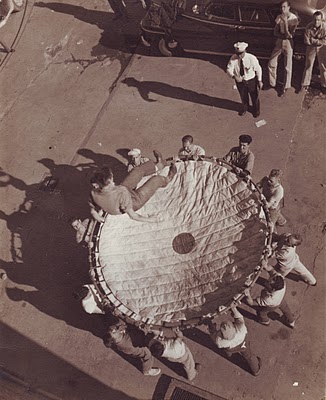 Something I find interesting is that there is a liquid market for “soft-landings” in todays technology landscape. If you build and don’t succeed, there are 10 or so places you can go to be acquihired…these conversations don’t begin with product or technology, but rather resumes and technical interviews. We are in a moment in time when downside case is not, in fact, a goose egg, as it has been portrayed for so many years…people think that when you startup a technology company, the likelihood of crapping out is great, and that is true…but today’s “crap out” actually looks more like a set of cushy jobs at “Bigco” with your closest friends and colleagues at about 130% of market salaries…
No founder endeavors to build for a soft landing…but even for investors, these deals can yield 25-100 cents on the dollar depending on how much $ was raised and how the acquirer performs over the year or two post deal. Note, however, that the soft landings that you read about where a team was acquihired, at least from what I’ve seen in the current market are not the “1 Million per engineer” that we scrawl on the backs of envelopes around board tables…the buyers that I see active in this “soft landing” market are increasingly frugal when it comes to doling out for even strong teams…deals are looking more like $2-4M in common/restricted stock with 4 year earn outs and less than $1M paid out to the cap table than they are “singles” from an investor’s standpoint. And…when you amortize the equity grants over 4 years, that “purchase price” starts to look a lot like market comp + 30% where the excess can be justified as a backloaded recruiting cost.
In these deals, Bigco’s M&A group looks a lot like HR on steroids. Should you find yourself in a position where “soft landing” or “crash landing” are the two options, and it’s time to figure out how to make it happen…here are a few rules of thumb:
1) Time is the buyer’s most valuable asset. A corp dev team has effectively infinite options for “soft landing” targets…especially post seed boom…so you are but one opportunity in a pretty full pipeline. The key metric that corp dev will look at out of the gate is “likelihood of close”…where they don’t want to waste their cycles on you if A) your not excited, B) your not reasonable, and C) your not efficient. Going into “soft landing” conversations with any posture other than “I want to get a deal done” seems like a pretty sure way to get booted out of the funnel. Now, if you have any options, or are strategic to Bigco, or have technology that will be usefull post deal, you are not in the “soft landing” funnel I am describing and there’s a whole other set of nuances to consider, but just for “soft landings” I think the best approach is to make corp dev believe that their investment in recruiting you will yield fruit…
2) An initial offer can often be 50% or what they’re willing to pay. Don’t be spooked or offended by the first offer Bigco makes
3) If your deal is a soft landing…nobody is getting rich. Not founders, not investors, not employess…and that’s fine…you are fighting to make a less than ideal outcome as good as possible. A typical “trick” that Bigco will employ is separating founders’ interests from investor’s interest. Large stock grants in the employee pool and minimal payouts to investors is the most classic example…buyers will keep dropping little carrots along the way in a negotiation…you have options on what you can push for in a series of terms…my suggestion is to optimize for investors and employees first, and yourselves as founders last…life is long, build good will…don’t be penny wise and pound foolish because this isn’t the deal that will define your career or lifestyle on the upside, but if handled poorly, could define it on the downside.
4) Pay attention to tax implications of the deal and make sure that it is structured in a way that is efficient for founders and employees…it will be more work for Bigco (and sometimes…hopefully…they have got it down to science already), but it’s worth fighting that battle up front
5) Talk to your lawyers all the time…don’t sneeze without their blessing…this is a scenario where it’s worth the $ to pick up the phone before acting
6) Your tone when talking to the buyer should always be “I’m pumped…assuming” or “We’re excited…as long as.” Bigco doesn’t want to buy you if you don’t want to be there…just like startups don’t want to hire people who don’t want to be there…so always lean in…but establish caveats… “assuming the vesting schedule is reasonable” “as long as we all get to work on things that interest us” etc…leverage is a very tricky animal, especially when they know you don’t really have any…but the threat that you will walk away once they’ve invested in the process is the only thing you’ve got, so love them…but don’t let them believe you’ll do the deal no matter what…because if they think that…they are sure to serve up “what”
7) If you find your way to the “close,” congratulations. These are strange times…there will come another era where failure = 0. You happened to crap out at the right time.
Read Full Post | Make a Comment ( None so far )Every photo you take increases my life expectancy…thanks
 I watch the diligence and intent with which human beings take photos and I cannot help but wonder what it is that drives us, on a seemingly instinctual level, to capture a representation of our physical environment AND that which is going on within it. Even before photos, we could trace whatever serotonin drip comes from taking a photo back to actions like writing, drawing, painting and so forth. Why do we love to capture each moment of life? Sure, there’s remembering…or the subtle thought of some future application to these actions, but I think it’s deeper than that. If you were designing a system with 7 Billion nodes (human species), how would you enable system level decision making to happen most smoothly? It definitely starts with communication of contextual information between nodes…and I believe that our instinct to photograph and capture is a physiological design that basically says “when node sees something, report back to system.”
If you believe that thought as a premise, an examination of the speed with which these recordings/reports are sent back to the system is a fascinating trend to examine. It used to be that a recording made by one human being could only reach and inform the decision making of those physically proximate to him (with some dissipating extension attributed to word of mouth), but generally if a caveman drew a painting on a cave, he was only influencing the thought and decision making of a subsystem which was his “neighborhood.” As more advanced and portable recordings developed, recordings could not only reach a larger population and penetrate subsystems across far distances, but the speed at which the broader systems “received word” of what was learned or observed increased. Even 10 years ago, with advanced camera technology, recordings only reentered system level consciousness after 72 hours of photo development…
With the advent of digital photography, both the number of nodes serving as recorders as well at the number of recordings per recorder have increased to a point where I’d venture to say, when combined with textual recording and voice based dissemination of information, basically everything that is occurring within the environment in which our system operates is being “observed and transmitted” back to the system in some way….and the speed at which information enters back into the system is essentially “real time.” So we have this network of little worker humans who are feeding the system real time contextual information essentially reporting back to it it’s own health and status…we are monitoring ourselves and the frameworks we have built to sustain us….i know it doesn’t seem that way, but imagine if every cell in your body was communicating it’s health and the health/transpiraitons of it’s immediate surroundings back to your brain…cancer would be detected instantly, you’d know exactly what food your body needs at any given moment, etc…as it currently stands, the human physiological system does not receive and decide in “real time”, but our broader system is getting there…
We started by recording and pushing “what happened” and that informed our system level decision making somewhat inefficiently but still effectively. We then move into a state of recording not “what happened” but “what is happening” and that shift is responsible for something of a renaissance in system level consciousness and self-optimization…basically, the speed at which our system can react to it’s context has shrunk to near zero…If I extrapolate out, once we are recording and pushing back to the system in perfect real time with perfect coverage, I believe we will move from a phase of “what’s happening” to “what will happen.” By applying machine learning principles to billions of real time feeds of “what’s happening” we will start to see machines anticipate the future with statistical significance…there are already examples of this occurrence in datarich, heavily monitored contexts such as financial markets…but soon we will have similar insight into previously “unrecorded” contexts. More photos, more push back to the system, new sensors, Nike Fuels, Jawbones, Smartphones, all driven and adopted by that same physiological urge that makes us take photos, perfecting system level monitoring of our context, carried out by human nodes, leading us into a world where the system will have a better view into an individuals life (the complete sensory recording of one node) than that individual has about his own context…
Afterthought: anyone seen fmri/chemical studies of what’s happening in the brain during the act of photography?
Read Full Post | Make a Comment ( 6 so far )when did “re” become an acceptable prefix to imagination?
 I hear smart venture capitalist repeatedly talk about this holy grail for startups of “replacing one of the native applications” on the iPhone. They revere instagram for “replacing the camera” and wonder desperately who will replace the address book, or the calendar, or the video application that come installed on your iphone when you take it out of the box. I think this is a really boring lens through which to look for giant opportunities. Sure, some of these applications that we are looking to replace are high frequency hi occurrence tools, so surely there is value in taking market share in those behaviors, but do we really think that Apple has conceived of and installed all of the most important/most valuable categories of application? Just because it’s hard to supplant apps with embedded distribution in these verticals, (and therefore anything that does, will by definition, be an amazing product), doesn’t mean that we need to dream in such a confined box. Personally, I’d much rather build something that causes Apple to say “oh shit, we should’ve skipped “calculator” and built a [insert your new category of application that owns a fast growing behavior which didn’t saliently exist when they guessed the first 12 things people would want to do with their new smartphones] than chase Ical for the next 5 years.
I hear startups often frame what they are working on as “reimagining” X. “we are reimaging the calendar in a social world” “we are reimagining payments” and I think to myself…that sounds bold…but isn’t it bolder to imagine than to reimagine? Sure you have a higher chance of crapping out, without a highly visible behavior that has been proven productizable through software solutions, but you only live once…wouldn’t you rather create the category than chase it?
**btw, this is not a know on Brewster. I am freaking pumped to see what Steve’s been working on and can’t wait to use it
Read Full Post | Make a Comment ( 6 so far )Email to John Lilly, now a blog post to you
 I sent this to JL this morning (in response to his push notification post today) but he hasn’t written back yet and I am impatient for smart feedback so now it’s a blogpost. Anyone want to build this with me in the next few weeks? shd be pretty easy mvp, harder with contextual triggers. holler. Email below:
Subject: You know what’s interesting
i just spent the last hour thinking about push real estate, wrote a bunch of stuff out, and then i opened twitter and read your post. btwn you and me, i think their is a whitespace in push experience as follows:
I see the light…i swear
It’s easier to hate than it is to love. Today I realized, that I have been doing a lot of hating of late. “I’m mad at market X”, “I’m annoyed with the way the press is covering Y”, “I can’t stand how founders do X”…this phenomenon has been pointed out to me not by colleagues or startup peeps, but rather by my closest friends and family. I get questions like, “dude, you are such a positive person, your blog makes it sound like your angry or depressed or something.” I sort of scratch my head and say, “I don’t know what to tell you, that’s what’s on my mind” or “sorry that was so negative…but it’s true.” I still stand behind those answers, but I realized something today…which is that I’ve been a little lazy in my writing lately. It’s easy to sit down to a blank page, think about the last thing that pissed you off, and go at it for 2 paragraphs in a way that will strike a chord with everyone else who has experienced something similar…it’s harder, however, to sit down to a blank page and think about what makes you a believer or what you really love or really appreciate…or the thing that gets you so spanking excited that you remember why you are in this business in the first place…
A long time ago, I realized something interesting as well…the posts that get the strongest reception, syndication, commenting etc…are almost always about “the struggle”…in one form or another, people seem to dig writing that they can identify with…and let’s face it…everyone who’s hustling and working their asses off, rich or poor, unproven or successful, is somehow experiencing struggle…and therefore can relate to it. So I write a lot about the struggle, and my struggle, which is ever changing, with new challenges, new aspects of life becoming less certain than they were, etc…but just because I focus on the struggle, doesn’t mean I’m struggling…it’s just great fodder for this forum…and writing is therapeutic…it helps to fight whatever forces are contributing to the struggle at any given time.
A friend recently sent me a note, after a particularly frustrated post I wrote, and said “hey dude, do you forget that your blog is public?”…I sort of smiled and wrote back “sometimes”…and that’s true, it’s no secret that unfiltered thought and content is way more compelling than sanitized writing…and I try to stay really true to whatever I’m thinking…where that ends up is occasionally in a post that I don’t end up publishing, but it’s boring to write only the thoughts and feelings that are “fit to print.”
I’m sure many of you read Dave McClure’s post today about his struggle over the years. He revealed some elements of his psyche that most push deep down, into dark places, and he served them up, really crisply and clearly, for all to read. You could read this post and walk away thinking, “wow, I had no idea Dave McClure was hurting like that,” but the truth is he’s probably not…at least not any more than any other conscious human…it’s why the post was tweeted a billion times today…because everyone can identify with the pings of inadequacy, self doubt, and unrealized aspiration which he elucidates. And there is something comforting about reading a post like that from a guy who’s public façade looks closer to bullet proof than unproven…the only difference between him, you, warren buffet and batman is that he wrote those thoughts down on paper and published them to the web.
This post is getting long, and I didn’t intend to dive as deep into the struggle as I ended up going, but the point I wanted to make was that there is a place for this pain in the spotlight of startup land, but there is also a place for hope and love and happiness. So I fear I’ve neglected those elements in my writing of late…too much struggle, too much hate,…so today I wanted to find the love…or more specifically my love…what do I love about startupland? What do I love about the decisions I’ve made? What do I find beautiful in the world of venture capital? These are themes that will not get retweeted…because nobody in the struggle wants to read about the deep satisfaction of someone who, at least on the surface, has less struggle then comfort, but for the sake of my mother, and my friends, who are worried that I have lost the optimism at the foundation of my self, below is a concerted effort to show you my rose colored view of this world:
1) I love the choice that permeates our ecosystem. There is no path, no ladder to climb, and no rules. There are decisions that will make your life harder, for sure, but if I can write shit, piss, fuck on this most public representation of myself and still persuade someone to give me $10 Million of their hard earned money, it is pretty clear that we are in a world where “Do You” trumps “fit in” or “you can’t say that on television” (Note: I have not raised $10M…yet…)
2) I love that the word “NO” fuels our progress at the same or faster rate than “YES.” I love being surrounded by people who do not sink their head at the first taste of adversity…I love that we work in a world where “NO” is received with an internal vow to make the deliverer of said word taste it hard…and let me tell you…for those who haven’t made the doubters taste it yet…when the day comes…it feels fucking great…
3) I love , love, love how fast we are able to go from the depths of hell to outerspace….it is a rare world that sends rocket ships into space every single day…and we are in it…and believe it or not, painstaking hard work earns you a seat on the ship.
4) I love that my train just stopped for the xfer at Jamaica and I closed my computer but I can keep writing this post on my phone because we live in the future…and I love that we work in the one industry on earth that gets to imagine what that future will be
5) I love that you don’t have to wait until your 45 years old to make decisions here. In a world where all decisions are imperfect, we have an amazing openness and acceptance of imperfection…we prefer 90% right at 23 years old o 94% right with 20 more years experience…which is awesome. I was about to right something I can’t stand about corporate culture but then remembered that this is a post about love and not hate.
6) I believe that we are pushing things forward in a direction that is better than the present. Sometimes I get frustrated by the forces in our market that work against this progress, whether they be contributors to the noise, or inefficient capital markets, or frankly human characteristics that work against us, but as a whole, when all is said and done, we are changing the way our population and environment exist, and we are doing it somewhat deliberately…which is so awesome. What an amazing role to play…it’s no wonder so many want to participate…beyond the noise, I see light…it is this light that inspires me and fuels my impatience and dissatisfaction at the same time
7) I love watching the entrepreneur come of age…to see a human being who has been something her entire life step into it is amazing…the founder who begins is unlocked for the first time…we work in a world where we witness birth every day…aside from OBGYN’s, I’m not sure who else can say that
I could think of 50 more, but my train just got to Penn Station. I love this world…if my words on this blog skew negative…it’s just because I believe and want for more
Read Full Post | Make a Comment ( 5 so far )Bio is the new Social (ish)
 Bio is the new Social (maybe not quite…but a wise man once told me, say something is and it becomes)…the Billguard thing has nothing to do with Bio, I just want it. But the other two are areas of focus for me these days and if you are building them, I’d be interested in speaking/investing/helping push things forward:
1) Billguard for healthcare/insurance claims: I can’t think of anything more annoying than letting my doctor’s office or hospital and health insurance company turn me into a human ping pong ball…the back and forth, he said she said, administrative nightmare that is determining weather or not I owe $32 for some incomprehensible invoice due 3 days before the fucking thing arrives in the mail is just so painful…I know there must be a better way..and e billing…and blah blah blah, but in the meantime, any form of scaled services business, or ideally a heavily software enabled services business that says “yo, all those ridiculous invoices and bullshit that you have to deal with, scan em’ or drop em’ in an envelope and we’ll watch your back” is all I really want…I just want to know that I’m not getting raked…and just because the hospital submitted to the wrong address, and I get a bill, doesn’t mean I should have to spend an hour on the phone trying to figure out who’s fault it is or if I really owe this money…even better, I’d love to know what care is going to cost me on the way in…this not knowing and then you get slapped with a bill for hundreds of dollars that you weren’t planning for is absurd…fine, ambulences cost money and your plan doesn’t cover it all…just give me a heads up so I don’t go buy a new tennis racquet this month before the bill comes…I don’t think we need to go for the hail marry here and try to change the way healthcare runs…but the HR Blocks of the world did it really simple: “everyone hates taxes, they are so confusing, nobody knows what they need to pay and what they don’t…so we’re gonna market the crap out of our cheap services that let’s you not worry about it”…people don’t pay HR Block to save them a ton of money…they pay HR Block for the piece of mind that it was done right without a ton of hassle…I think you could do the same and save people from the worry of the healthcare/insurance ecosystem.
2) Wearable sensors for biodata: who’s measuring my endorphin levels, or my perspiration, or my heart rate, blood pressure, pupil dialation, sugar levels, or really any other biological dataset…who is taking information usually collected in the doctors office and productizing hardware and microhardware meant to enable consumer monitoring and tracking? Withings is pushing on this in some regards…but I want lighter weight…more biology…less machinery…I don’t care if your using existent sensors in devices with penetration or brand new stuff…I just want novel bioinformatics capture. Thanks
3) Innovation at the interface layer between hardware/software and human physiology/users: Who is thinking beyond billions of people stupidly tapping away on the glass screens on our phones…how do we interact with out devices with less friction…I see folks reducing the contact points with devices through mechanisms like push, background processing/ux, etc…but who’s using the microphone in interesting ways? Who is viewing an engaged user’s physical body as the interface to a new user? Who is pushing on Google Goggles without billions in R&D behind them? Who is creating an IFTTT that says, “if my blood pressure rises above the norm, play that meditation podcast I downloaded last week.” I love interfaceless UX, but what I really want is more deeply integrated interface between myself and my device and my software…and the interface goes both ways, I don’t just want better consumptive experience, I want to push data to hardware/software without disrupting my offline experience…who is building hardware that is meant to live inside my physiological system, not distinct from it, or even attached to it, I want to know who is connecting my biological systems to software/hardware systems (especially for non-medical applications)…I realize how far off we are from brain system to software system, but there are many less complex physiological systems in the body that have direct application when communicating with software applications…
Read Full Post | Make a Comment ( 5 so far )« Previous Entries


 Jordan Cooper's Blog: startups, venture capital, etc...